What a wolf spider looks like
Large, hairy and built for running: a robust brown, grey or tan spider with dark markings, long hairy legs, and an abdomen noticeably longer than it is wide. It is one of the biggest spiders you will meet that does not sit in a web.
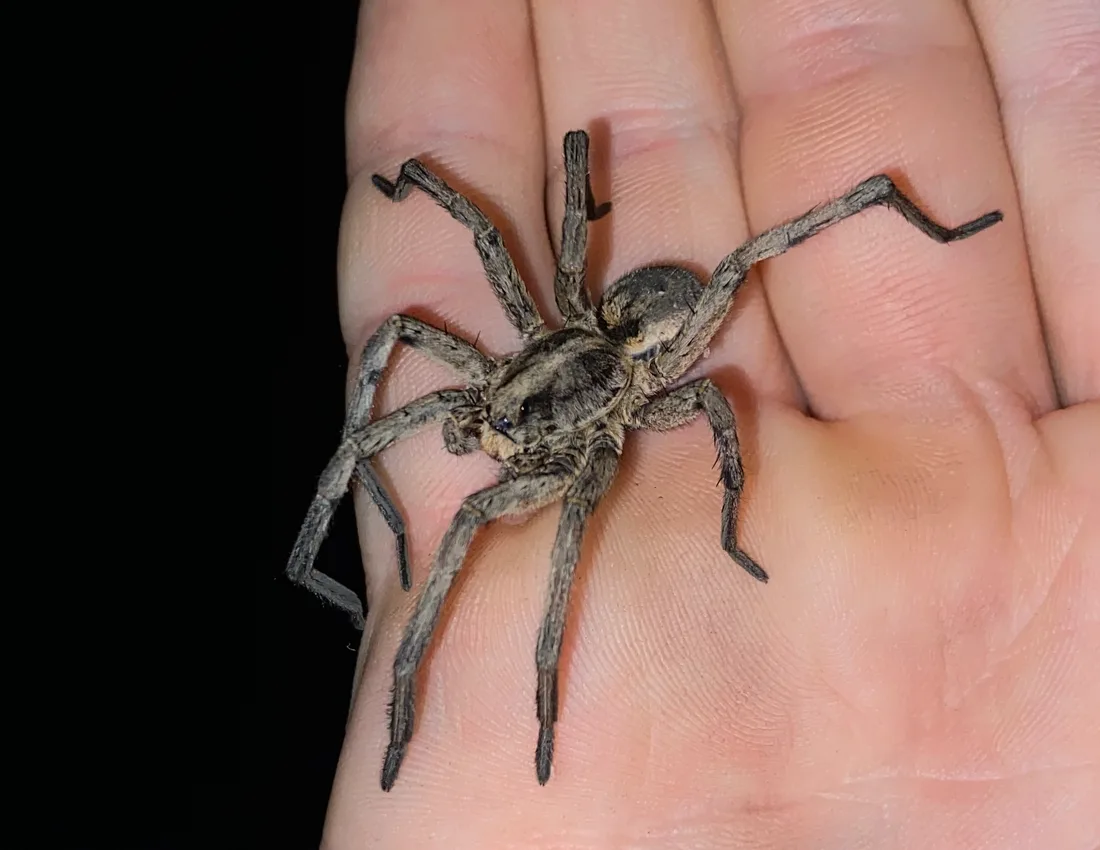
Body length runs from about 1/4 inch to 1 inch (6–25 mm), and females are larger than males. The largest species go further: a female Carolina wolf spider (Hogna carolinensis) is 22–35 mm, a male 18–20 mm. Those are the ones that get photographed. Most wolf spiders are far smaller — bodies around a centimetre or less — and the tiny pirate wolf spiders are under 1/8 inch.
Colours are muted and the pattern is usually a darker stripe down the middle of the body. Some species have banded legs; the biggest ones tend to have plain legs and scattered grey hairs. There are roughly 200 to 240 species in the United States, so the details vary — which is exactly why the eyes matter more than the markings.
The eyes: the test that settles it
A wolf spider has eight eyes in three rows — four, then two, then two. Four small eyes sit in a straight line across the front of the face. Above them are two large eyes. Above those, two more, set wide apart on top of the head.
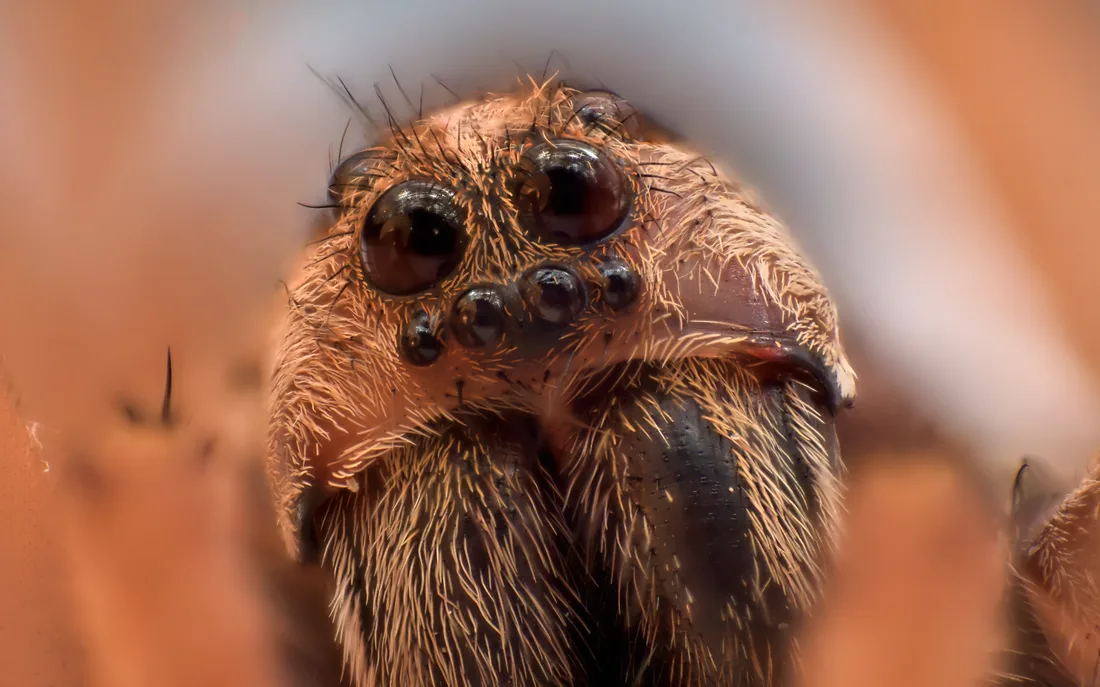
Those two big middle eyes are the whole diagnosis. Seen from above, they and the rear pair form a square of four larger eyes on top of the head, with the row of four small ones below and in front. Nothing else you are likely to find in a house or yard has that arrangement.
One correction worth making, because it is repeated constantly: a wolf spider does not have "two rows of four eyes." That is a different arrangement belonging to other families, and it is the single most common error in online wolf spider guides.
Wolf spider or brown recluse?
This is the question nearly everyone is really asking. A wolf spider can have dark patches that read as a violin shape, and that is enough to start a panic. Four things separate them, and the first is decisive.
| Wolf spider | Brown recluse | |
|---|---|---|
| Eyes | Eight, in rows of 4-2-2, with two large ones | Six, in three separated pairs in a semicircle |
| Legs | Hairy, often banded or spined | Plain and uniformly coloured, no bands or spines |
| Body | Hairy and robust, abdomen longer than wide | Smooth, body no more than 3/8 inch |
| Range | Everywhere in North America | South central Midwest and South only |
The violin mark itself is a poor test even for the recluse — it varies in intensity and is faint to absent in several recluse species. The six eyes in three pairs are the real feature. If you can count eight eyes with two big ones, you are not looking at a recluse, whatever the marking looks like.
Geography does more work here than people expect. The brown recluse occupies a band from southeastern Nebraska to southwestern Ohio and south through Texas to north Georgia. In a study running from 2000 to 2005, Californians submitted nearly 600 spiders they believed were brown recluses; exactly one was. If you are outside the range, the odds are overwhelming that you have something harmless — see how to identify a brown recluse for the range in detail.
The egg sac, and the young on her back
This is the wolf spider's signature. The female spins an egg sac and attaches it to her spinnerets, dragging it behind her everywhere she goes. When the spiderlings hatch, they climb onto her abdomen and ride there.
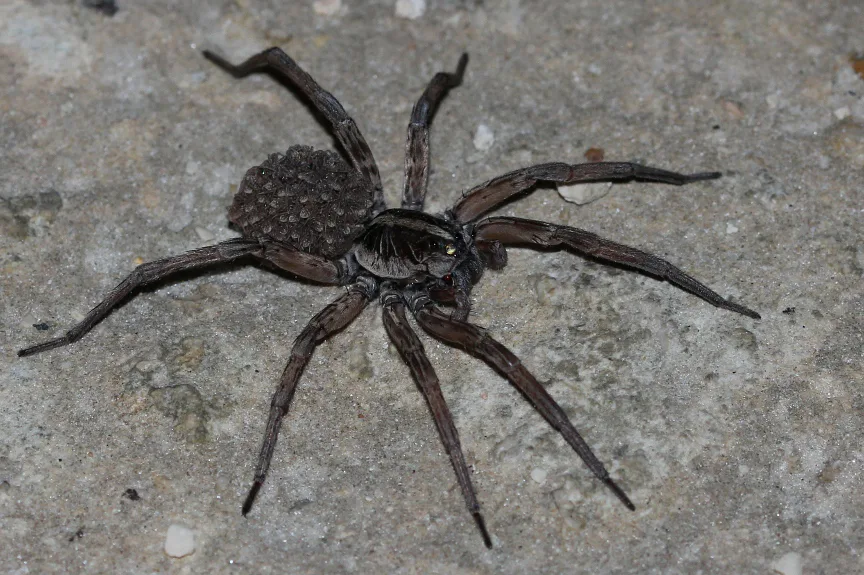
She opens the sac with her fangs when the eggs are ready. The young hold on with the help of specially shaped hairs on her abdomen, and if one falls off it runs back up a leg. They stay aboard for roughly one to two weeks — sources differ, and it varies by species — before dispersing. A sac may hold over a hundred eggs.
Among the spiders you are likely to meet around a North American house or yard, no other common family does both of these things. It is the clearest confirmation you can get without looking at the eyes.
The flashlight test
Wolf spider eyes have a tapetum — a reflective layer behind the retina that bounces light back through it, which is what lets them hunt at night. Shine a light at one in the dark and the eyes glow back, pale green, like a cat's.
The trick most people get wrong: the light has to be next to your own eyes for the reflection to reach you. Use a headlamp, or hold a flashlight against your temple. Sweep a lawn on a warm night and the effect is startling.
One caveat. Eyeshine tells you that you have found a hunting spider, not specifically a wolf spider — fishing spiders and crab spiders have it too. It narrows things down; it does not confirm them.
No web, and how it hunts
Wolf spiders build no web to catch anything. They hunt on the ground, either running prey down or sitting still and ambushing it, working largely from vibration — wingbeats, or footsteps on soil. That is why finding one loose on a floor or wall is normal behaviour rather than a sign of anything.
They do make silk, which is a common point of confusion. They spin egg sacs, and they build small silk-lined retreats in soil, under boards, stones and firewood, and behind siding. "No web" means no web for catching prey, not no silk at all.
Most species are mainly nocturnal, though sources disagree on how strictly. Some are active by day as well, particularly near streams and lakes.
What else it might be
Two of these are mistaken for wolf spiders constantly, and the third is the one you probably actually have if the spider was indoors.
| Spider | How to tell it apart |
|---|---|
| Grass spiderAgelenopsis | Sits in a flat sheet web with a funnel retreat at one edge, and has two long finger-like spinnerets projecting from the rear of the abdomen — a wolf spider has neither. Body 9–20 mm. These are the fast spiders people see running indoors in autumn. |
| Nursery web spiderPisaurina | All eight eyes are about the same size, with no large pair. The female carries her egg sac in her jaws, out in front, then builds a silk nursery in a folded leaf — a wolf spider drags hers behind on the spinnerets. Body 1/2 to 3/4 inch. |
| House spiderEratigena | The big, hairy, fast spider indoors is usually one of these, not a wolf spider. Wolf spiders are not part of the indoor spider fauna of North America at all. |
Fishing spiders are close relatives and look similar, but their front four eyes sit with the outer two higher than the inner two, and they can run on water. Wolf spiders are entirely terrestrial.
Is a wolf spider dangerous?
No. A wolf spider bites only when it is mishandled or trapped against skin. What follows is pain and redness, sometimes with local swelling, and it generally settles within 24 hours. No serious medical consequences have been recorded from North American wolf spider bites.
The necrosis claim deserves a direct answer, because it is everywhere. It is wrong, and it has been tested twice:
- Brazil, 1990. 515 wolf spider bite patients treated over four years. Pain, usually mild, was the main symptom in 83% of cases. No local necrosis was found in any of them. The authors concluded the older necrosis cases in the literature had been misdiagnosed recluse bites.
- Australia, 2004. 45 bites where an arachnologist identified the spider. Pain in all of them, lasting a median of ten minutes; redness in 67%; swelling in 20%. Necrotic ulcers: zero.
Both studies are from outside the United States — no comparable US series exists — but the conclusion matches what every US extension service says about the bite. The myth traces back to a single 1925 report from Brazil, and it still turns up in textbooks.
If a bite is spreading, darkening, blistering or still getting worse after a few days, have it looked at regardless of what you think bit you. Most marks blamed on spiders turn out to be something else entirely — the bug bite identifier covers what else leaves a mark like that.
Why it is in your house
It wandered in, and it is on its own. Wolf spiders are outdoor animals; no member of the family is part of the North American house spider fauna, and individuals that come inside generally do not survive there. What you have is one lost spider, not an infestation.
The timing is seasonal and has a reason behind it. Mating happens in autumn and the males die before winter. The mated females go looking for somewhere protected to overwinter, and houses qualify. They lay their egg cocoons the following May or June.
A cup and a piece of card puts it back outside. If you want to keep them out, the useful work is outdoors: move firewood, stones and boards away from the walls, and cut down the ground cover they hunt in right against the house.
Still not sure what you are looking at? The spider identifier reads body shape, leg proportion, eye arrangement and web type from a photo, and the two spiders actually worth recognizing are the black widow and the brown recluse.