The four spiders you actually find indoors
Out of thousands of North American species, indoor sightings come down to a short list. Start with the web — it separates them faster than the spider does.
| Spider | The web | Size and look | Harmful? |
|---|---|---|---|
| Common house spiderParasteatoda tepidariorum | Messy three-dimensional tangle in a corner | Female 3–9 mm, drab tan to grey, round abdomen, hangs upside down | No |
| Cellar spiderPholcus phalangioides | Irregular mesh, hangs inverted in it | Body 6–8 mm, forelegs around 50 mm — the legs are the whole impression | No |
| Giant house spiderEratigena atrica | Sheet web with a funnel hole in the middle | Body 1/2–1 inch, leg span up to 4 inches, hairy and not shiny | No |
| Hobo spiderEratigena agrestis | Funnel retreat, usually hidden under something | Female 9.5–16.5 mm, brown, plain legs with no dark bands | No — see below |
The last two live in the Pacific Northwest and are near-impossible to tell apart without a microscope. The first two are found across the country. If your spider is large, hairy and running loose with no web at all, it may be a wolf spider that wandered in — though indoors, the big fast one is usually a male house spider.
The common house spider
A small, drab spider — yellowish, tan, brown or grey with darker mottling — sitting upside down in a messy tangle of web in a corner. The abdomen is round and higher than it is long, usually with side streaks, V-shapes behind, and a whitish patch near the top. The legs are ringed with dark bands.
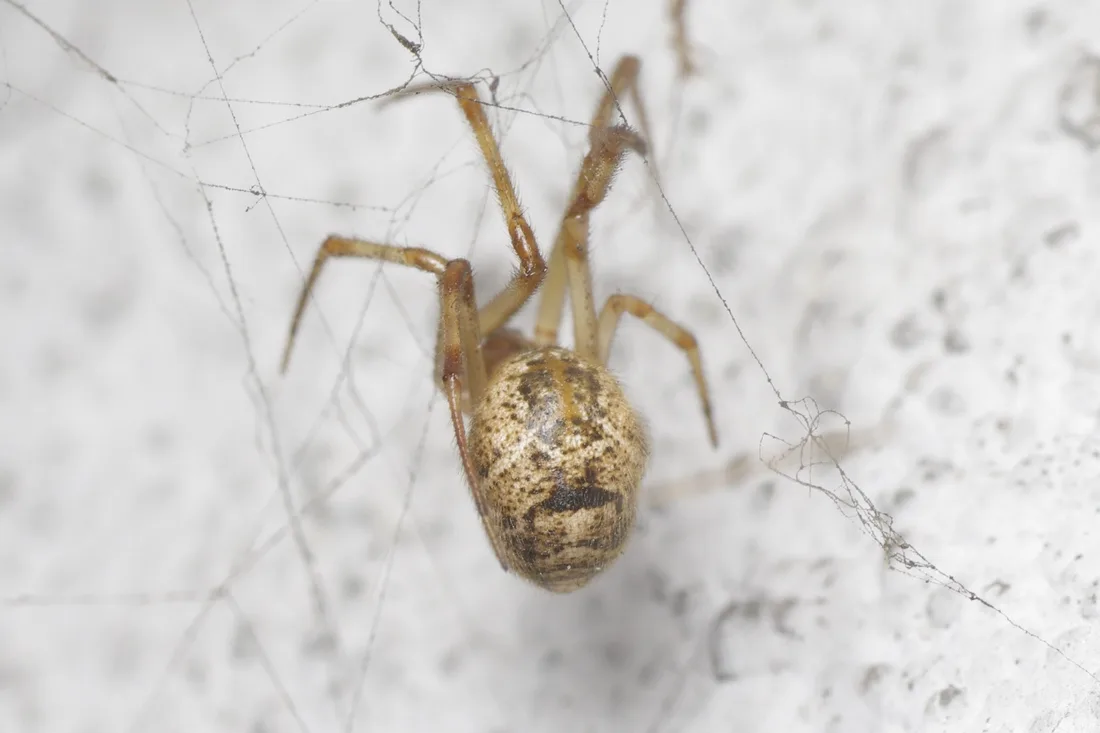
Females run roughly 3 to 9 mm in body length — about 1/8 to 3/8 inch — and males are smaller, often with orange legs. Sources differ on the upper end of that range, so treat it as a rough guide rather than a measurement.
It belongs to the Theridiidae, the cobweb spiders — the same family as the black widow. That explains the body plan: globular abdomen, spindly legs, hanging inverted in a three-dimensional tangle rather than a flat orb. What separates it from a widow is colour and marking, not shape. A widow is glossy jet black with a red hourglass underneath; this is drab and mottled with no hourglass at all. If that is the question you came with, how to identify a black widow covers it properly.
You find them in wall and window corners, around garage doors, in basements, barns and crawl spaces, and behind doors left open — damp places especially. Several teardrop-shaped egg sacs often hang in the web at once, each holding somewhere around 100 to 400 eggs.
The bite is not medically important. The few verified bites on record produced pain that built over about an hour, a red mark, and discomfort lasting 4 to 24 hours.
The cellar spider, or daddy long-legs
A tiny pale body on enormously long, thin legs, hanging upside down in a loose mesh of web in a ceiling corner. The body is 6 to 8 mm; the front legs of an adult female are around 50 mm — five or six times the body length.
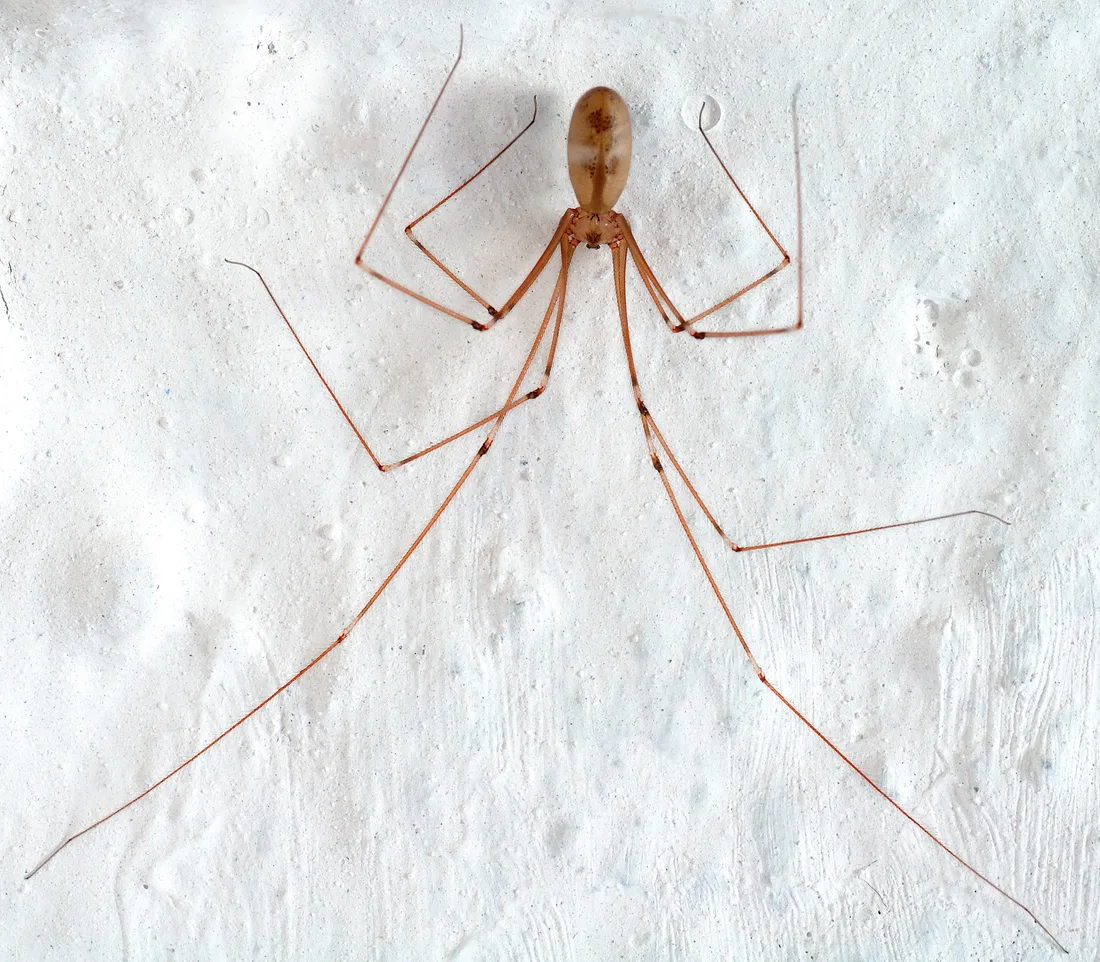
They are grey, tan or whitish, with an abdomen about three times as long as it is wide. Some species have darkened leg joints that give a knobby-kneed look. They live indoors year-round in cellars, garages, warehouses and any dark, quiet, protected corner, and they are long-lived: about a year to reach maturity, then two or more years as adults.
The behaviour worth knowing: disturb one and it vibrates rapidly in a circle in its web, turning itself into a blur that is genuinely hard to focus on. It is a defence against predators, and it is the easiest confirmation you will get.
The daddy long-legs venom myth
You have heard it: daddy long-legs have the most powerful venom of any spider, but their fangs are too short to break human skin. It is false in both halves, and the first half is not even a real question — it has never been measured.
The Burke Museum's arachnology curator calls it "a full-fledged urban legend, with no basis in fact whatever." UC Riverside's spider research group notes that there are no toxicological studies testing pholcid venom on any mammalian system at all — so there is no finding to support, and nothing to compare. What is known points the other way: one study found cellar spider venom unusually weak in its effect on insects.
Part of the confusion is that three unrelated animals are called daddy long-legs, and only one of them is a spider:
| Called "daddy long-legs" | What it actually is | How to tell | Venom |
|---|---|---|---|
| Cellar spiderPholcidae | A true spider | Two body sections, eight eyes clustered at the front, spins silk | Has venom, but ordinary |
| HarvestmanOpiliones | An arachnid, not a spider | One apparent body segment, pill-shaped; spins no silk at all | None at all — no venom glands, no fangs |
| Crane flyTipulidae | An insect | Six legs and two wings | None |
On the fangs, authorities genuinely disagree and it is worth saying so. UC IPM writes that cellar spiders are "only marginally capable of biting humans because their fangs are too short to pierce people's skin." UC Riverside rejects that reasoning directly: brown recluses have a similar short, hooked fang structure and bite people perfectly well, so fang length is not what is stopping them. What nobody disputes is that cellar spiders are not known to bite people and are not a medically important species.
The giant house spider and the hobo spider
In the Pacific Northwest, the big spider on the floor or trapped in the bathtub is usually a giant house spider: body 1/2 to 1 inch, leg span up to 4 inches on a large adult, brown to greyish-brown, hairy and not shiny. It builds a sheet of web with a funnel hole in the centre and sits in the hole waiting.
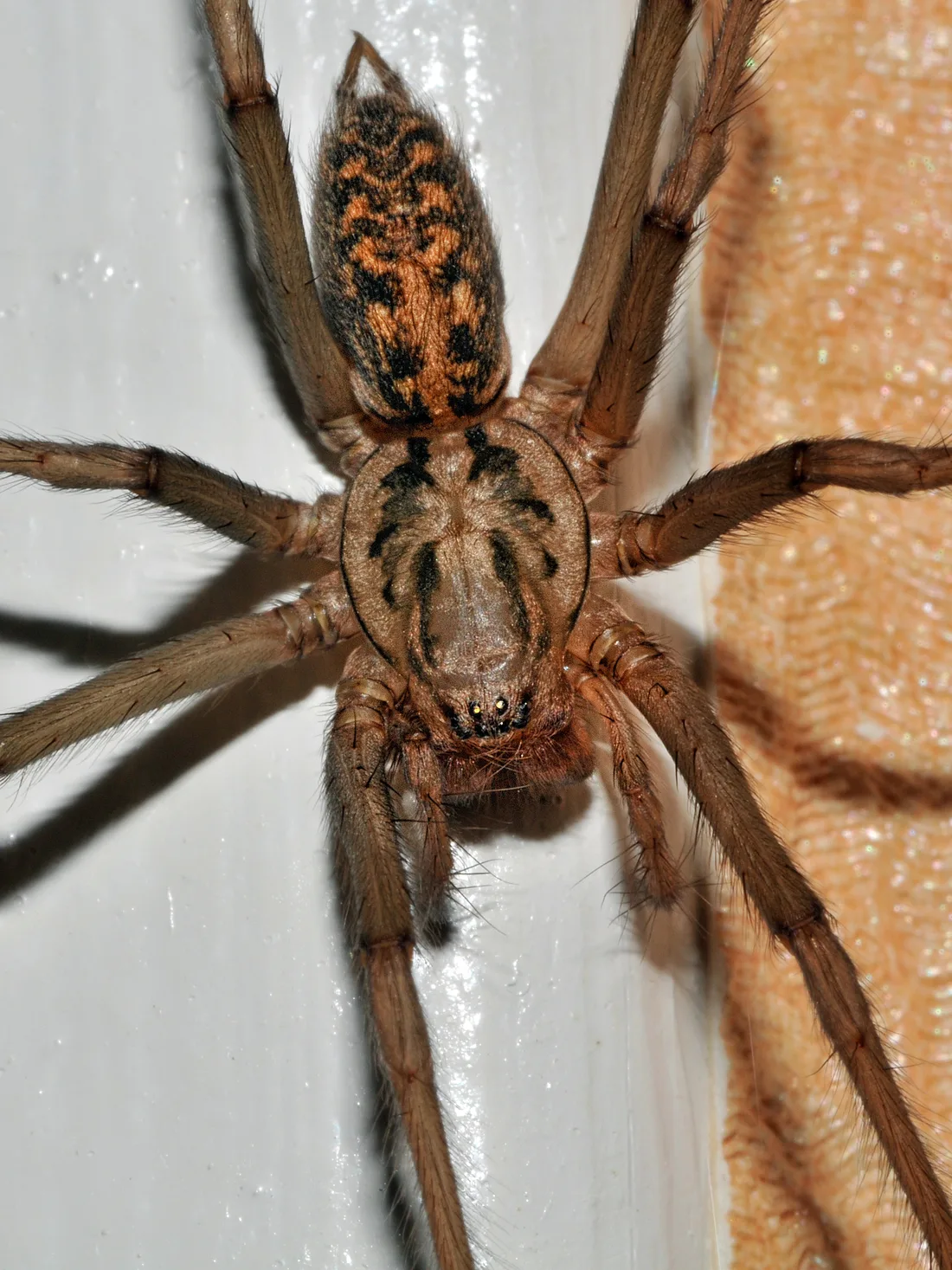
It is common in and around homes west of the Cascades in Washington, and in coastal British Columbia and Oregon. East of the Cascades in Washington it is not found. It is not known to pose any threat to people, and when startled it runs — fast.
A note on the name, since you will see it written several ways. "Giant house spider" covers a cluster of near-identical species — Eratigena atrica, E. duellica and E. saeva — that were lumped together in 2013 and separated again in 2018, and that cannot be told apart without examining the genitalia. The one in the Pacific Northwest is usually E. duellica. For practical purposes they are the same spider with the same answer: harmless.
The smaller males are routinely mistaken for hobo spiders. In the Puget Sound region giant house spiders outnumber hobo spiders and are far more often the one people encounter, so the odds favour the harmless answer before you even look.
Which matters, because you cannot identify a hobo spider by eye. The chevron markings people rely on are one of the commonest pattern types among spiders, shared by thousands of species, and some hobos do not have them. Funnel webs are built by the whole family. Enlarged palps just mean the spider is male. The Burke Museum's position is blunt: a naked-eye view is simply not enough, and confirmation needs a microscope at 30x or better.
The hobo's US range is the Pacific Northwest — British Columbia east to Montana, Wyoming and Colorado, and south through Oregon into northern Utah. It does not live in California.
The hobo spider and the necrosis claim
For about two decades the hobo spider was treated as a cause of flesh-destroying wounds in the Pacific Northwest. That claim came out of work published between 1987 and 1996, and it has since been taken apart.
- 2001. A venom study found hobo spider venom did not produce necrotic wounds in rabbits.
- 2004. A review in Annals of Emergency Medicine found only one verified bite associated with a necrotic lesion, in a patient with pre-existing conditions.
- 2014. An Oregon study documented a verified bite that produced only temporary pain and redness.
The official positions followed. The CDC's venomous-spiders page now lists only two spiders — black widows and brown recluses — and the hobo spider is not on it, a removal reported in September 2015 after the American Arachnological Society and others petitioned for it. Washington State Department of Health states there is no evidence hobo spider venom has caused skin necrosis in people. Utah State University Extension notes the CDC does not list hobo spiders among species toxic to humans, and describes them as non-aggressive and unlikely to bite.
UC IPM puts it carefully rather than absolutely: the hobo spider "is no longer considered of probable medical importance," while adding that definitive proof is still lacking. That hedge is worth keeping. The honest summary is not "proven harmless" — it is that the evidence for harm collapsed under examination.
One more correction. The hobo's old common name, "aggressive house spider," came from a misreading of its scientific name: agrestis means "of the fields," not aggressive. It is neither aggressive nor, strictly, a house spider.
Why there are more spiders in autumn
Not because they are coming in from the cold. The indoor spider peak is in August and September — not a cold time of year — and what is moving is mature males leaving their webs to look for females.
This is why the spider running across your floor in September is usually male. A WSU entomologist reports that of the spiders brought to his office each autumn, nine times out of ten it is a male, because males are the ones wandering. Utah State Extension describes the same thing: spiders nearing the end of their life cycle, searching for mates and for places to lay egg sacs.
The other half of the answer is that most of these spiders never came in from outside at all. Burke Museum's Rod Crawford estimates that fewer than 5% of the spiders you see indoors have ever been outdoors — house spiders are largely indoor species, several of which have lived in buildings since Roman times and are poorly suited to North American outdoor conditions. It is his professional estimate rather than a published measurement, but the underlying point is well supported: indoor spiders are usually not the same species as the ones in your garden.
Not everyone agrees the cold plays no part. A WSU graduate entomologist quoted in the same release thinks spiders preparing for winter will take a warm building if they can find one. So warmth may contribute at the margins. What it does not do is explain a peak in late summer.
If you want fewer spiders indoors, the lever is the food supply: the more insects inside a building, the more likely spiders are to live there.
Which indoor spiders actually matter
Two, and neither is a typical house spider. The CDC lists widow spiders and recluse spiders, and nothing else.
| Spider | Where | Where in a building |
|---|---|---|
| Widow spidersLatrodectus | Throughout North America, most common in the South and West | Garages, sheds, woodpiles, crawl spaces, rodent holes — peripheral spaces, not living rooms |
| Recluse spidersLoxosceles | The South and central Midwest only | Undisturbed storage, boxes, clothing left unworn |
Even those are less dramatic than their reputation. Around 2,200 black widow bites are reported annually in the United States, and there has been no recorded death since 1983. Only adult and larger immature females can bite through human skin at all; a male widow has venom but fangs too small to break skin.
The recluse's range is the point people miss. A national survey collected 1,773 arachnids sent in from 49 states as suspected brown recluses, and concluded that recluses are virtually restricted to their known distributions while being perceived to exist everywhere. In South Carolina, 940 physicians reported 478 suspected bites in a single year against one recluse ever verified in the entire state.
Yellow sac spiders (Cheiracanthium) are the footnote: they can bite when trapped against skin in clothing or bedding, and it feels like a bee sting with redness and sometimes swelling. Painful, not dangerous.
There is a real safety point buried in all this. A spreading or necrotic wound is far more likely to be an infection than a spider bite — MRSA and other staph and strep infections are commonly misdiagnosed as recluse bites, along with shingles, Lyme disease and a long list of other conditions. Getting it wrong means the real problem goes untreated. If a wound is worsening, have it looked at, and do not let "spider bite" close the question.
Three more things that are not true
"You swallow eight spiders a year in your sleep." No such case is on formal record anywhere in the scientific or medical literature — no specimens, no eyewitness accounts. The story about where the statistic came from is better than the statistic: it is usually credited to a 1993 magazine column by one "Lisa Birgit Holst," written to show how readily people believe things. That name is an anagram of "This is a big troll." The origin story is itself a hoax.
"Spiders crawl up the drain into the bath." Modern drains have a liquid-filled trap that a spider cannot get through. What happens is the reverse: the spider climbs down the wall looking for water and then cannot climb back up the slippery sides.
"Put it outside and it will be happier." House spiders are adapted to indoor conditions and generally do not survive outdoors. Releasing one outside usually kills it — which may still be the trade you want to make, but it is worth knowing that is the trade.
Still not sure what you have? The spider identifier reads body shape, leg proportion, eye arrangement and web type from a photo. If what you have is a mark on your skin and no spider, start with the bug bite identifier instead.