What a black widow looks like
The one people mean is the adult female: a shiny black spider with a large, round abdomen and a red hourglass on the underside. Her body is 8–13 mm long — about 1/3 to 1/2 inch — and 25–35 mm with the legs spread.
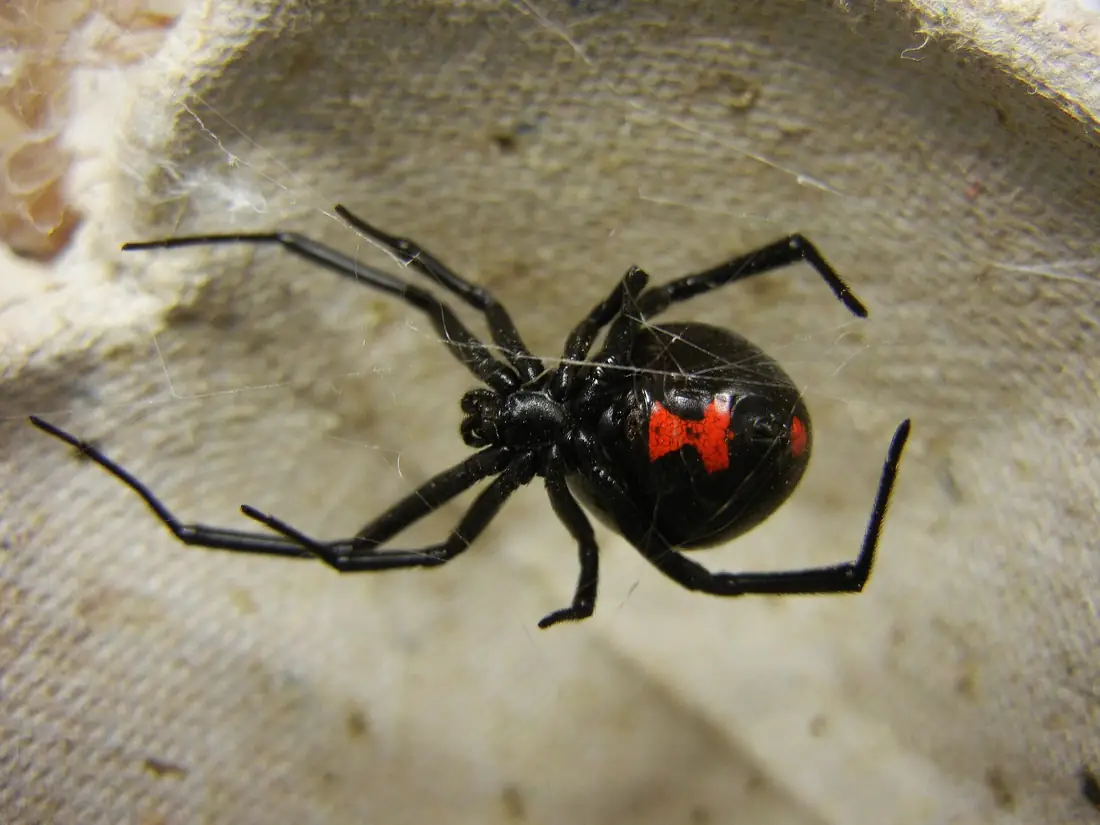
Males are much smaller and rarely noticed. They lack the hourglass and may have light streaks or red spots on the abdomen. Spiderlings start out white and take on adult coloring over several molts. Only the bite of the female — usually the adult female — is medically significant.
The hourglass, and when it is not there
The hourglass is on the belly, not the back. A widow usually hangs upside down in her web, which is why the mark is often the first thing people see — and why the same spider seen from above can look plain black.
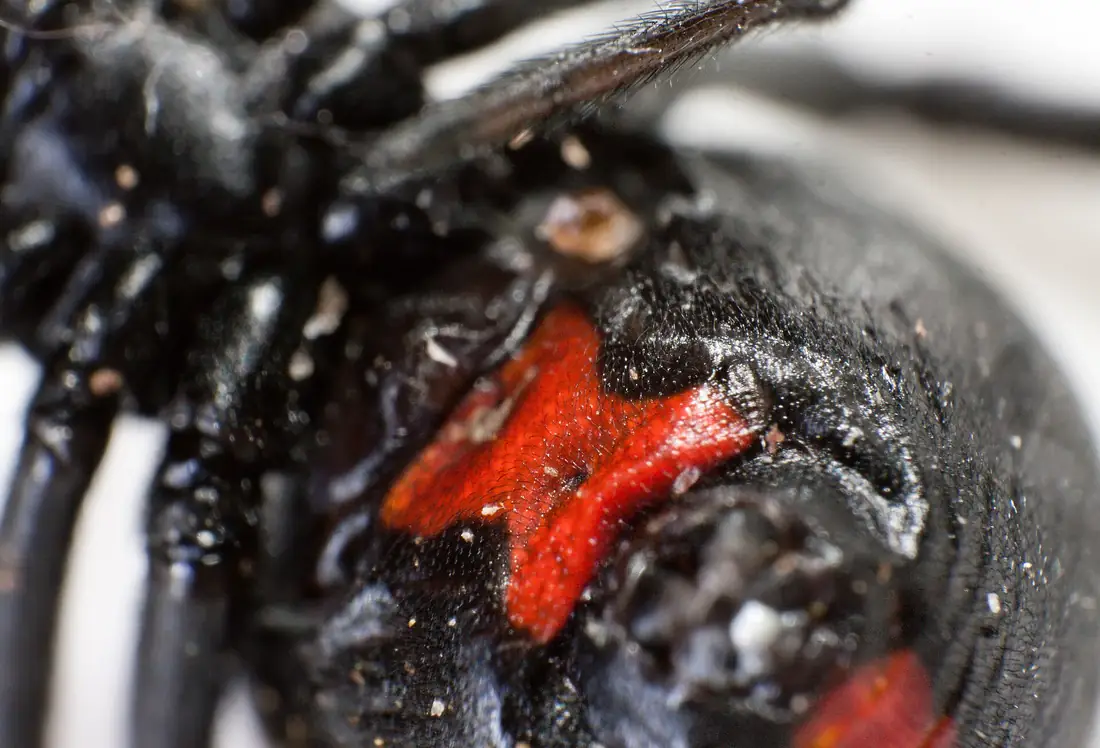
It also varies more than the textbook picture suggests. Three widows are native to the United States, and the mark differs between them:
| Species | Where | The hourglass |
|---|---|---|
| Southern black widowLatrodectus mactans | The Southeast, north to Ohio and west to Texas | A complete red hourglass |
| Western black widowLatrodectus hesperus | The West, including most of California | Anything from two joined triangles to two separate ones to faint red blotches |
| Northern black widowLatrodectus variolus | Further north | Usually present, but some individuals lack it entirely |
An introduced relative, the brown widow, is established in Florida. It is lighter in color, and although its venom is potent, it is timid enough to be considered less of a threat to people than the native black widows.
The web
A widow's web has no pattern: an irregular, sticky tangle with unusually tough strands, built low down in a sheltered spot. The spider hangs in it belly-up, hourglass showing.
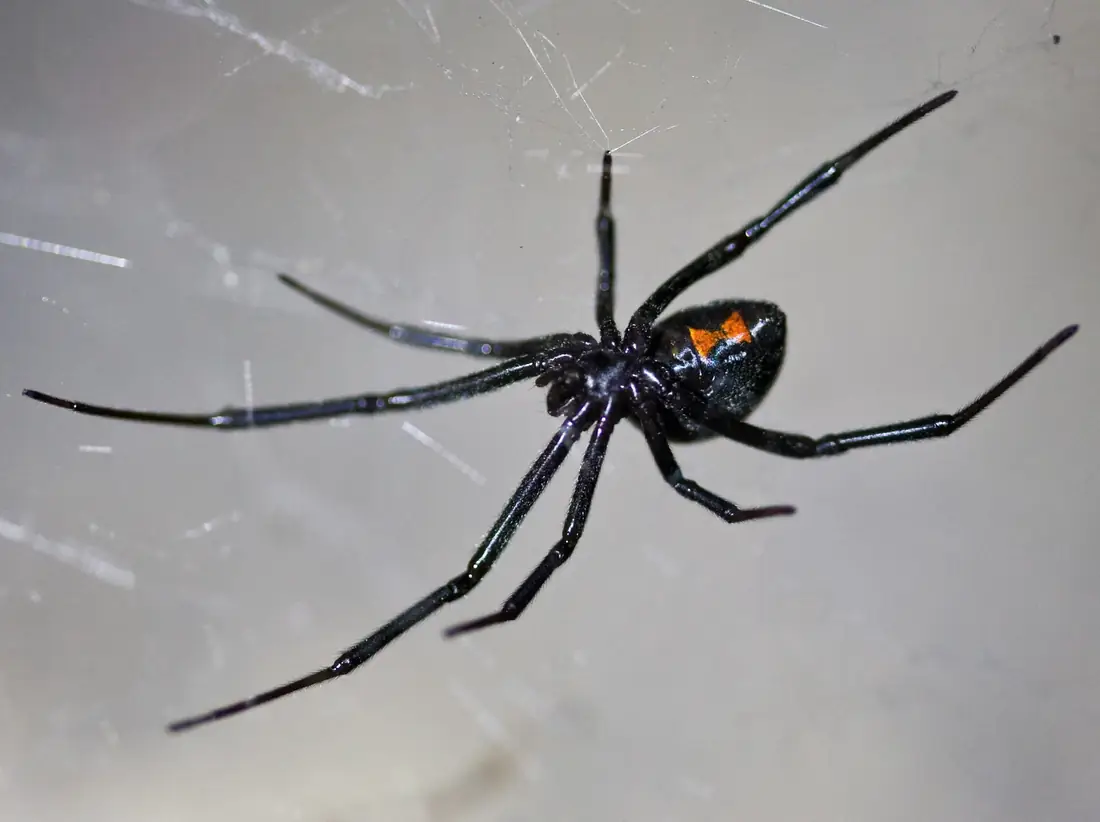
Egg sacs often hang in the same web — beige, about 1 to 1.25 cm across, each holding around 220 eggs.
Where you find them
Dark, dry, undisturbed places: woodpiles and rock piles, garages, sheds, basements, outhouses, hollow stumps and rodent burrows. Wear gloves when moving firewood, stones or boxes that have sat untouched in places like these.
The false black widow: the usual mix-up
The spider most often mistaken for a black widow is the false black widow, Steatoda grossa. It has the same round-bodied shape, and it is a common spider inside homes in the South and West.
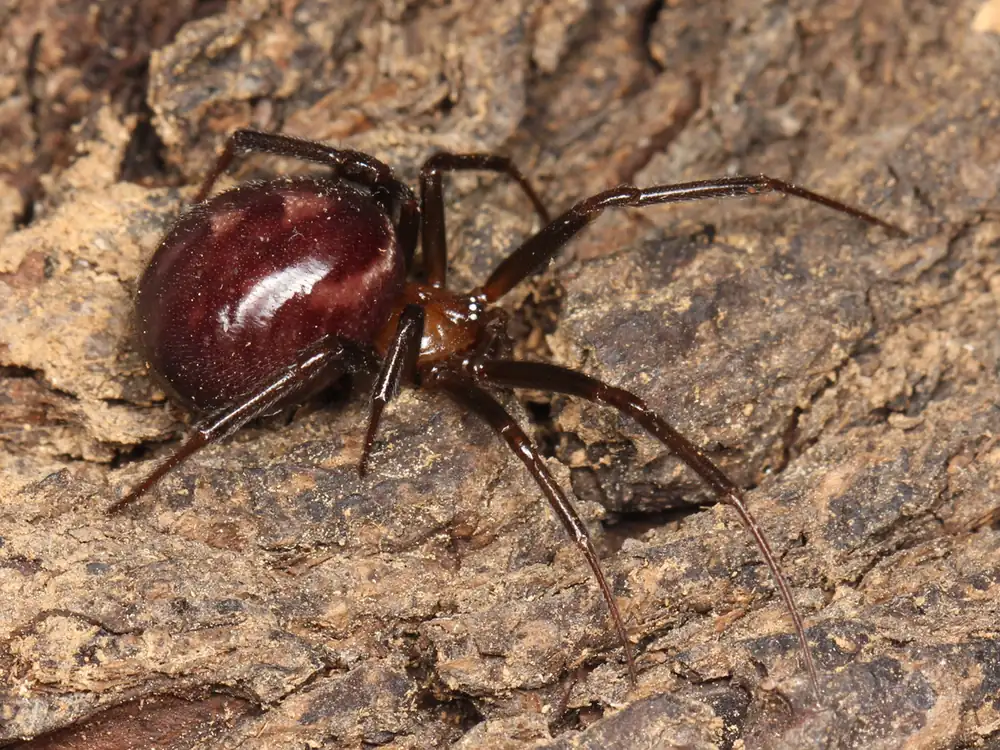
| False black widow | Black widow | |
|---|---|---|
| Color | Purplish-brown to black, with pale markings on the abdomen | Shiny black |
| Red hourglass | None | On the underside |
| Body length | 6–10.5 mm | 8–13 mm |
| Bite | Similar symptoms but much less severe; pain can last 1 to 60 hours | A nerve toxin that can cause pain and cramping well beyond the bite |
What a bite does
Black widow venom is a neurotoxin: it acts on the nervous system rather than the skin, so the effects spread beyond the bite itself.
Muscle pain and tightness, often in the chest, are among the most common effects, and the pain can spread to the abdomen with cramping and nausea. Restlessness, anxiety, sweating, and difficulty breathing or speaking can follow. Symptoms usually worsen through the first day and ease after two or three days, though mild symptoms can linger for weeks.
Serious outcomes are uncommon. In 2010, 2,168 black widow bites were reported in the United States; 892 were treated in a health care facility and none were fatal. Small children and older adults are at higher risk.
What to do after a bite
Wash the bite with soap and water and put a cold pack on it. If there is more than local pain — cramping, sweating, chest or abdominal pain, or any trouble breathing — get medical care. In the United States, Poison Control at 1-800-222-1222 can advise on any suspected widow bite.
If you can, bring the spider or a clear photo of it. If all you have is the bite, the bug bite identifier describes what else it is likely to be, and the brown recluse is the only other North American spider of medical note.