What a jumping spider looks like
Small, compact and hairy, with a blocky front end and short legs. The ones people notice run about 4 to 12 mm — roughly 1/6 to 1/2 inch — though the largest US species reach about 22 mm. It moves in quick jerky hops, in daylight, out in the open.
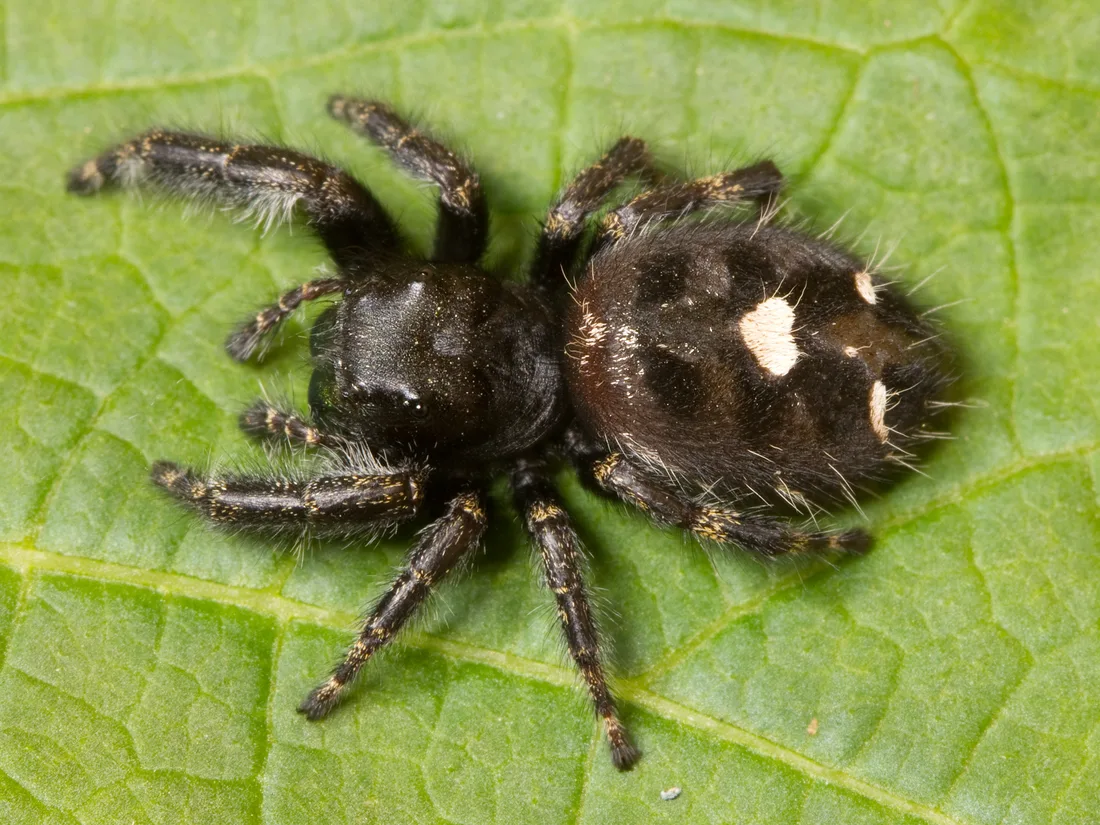
The stocky look has a specific cause, and it is not what people assume: jumping spiders do not have enlarged, muscular jumping legs the way a grasshopper does. The legs are short and unswollen. What makes the animal look compact is the high, blocky front section carrying those oversized eyes.
Colours run from black, brown and grey to genuinely bright — red, orange, metallic blue and green patches, copper, gold and silver. In the genus Phidippus, the chelicerae supporting the jaws are often iridescent green or blue, which is a striking and useful clue.
One honest caveat before you try to name a species: patterning varies a great deal even within a single species, so colour alone is an unreliable guide. Bold jumper spots are orange in young spiders and white in adults — the same spider, two different descriptions.
The eyes: nothing else looks like this
Eight eyes in three rows, and the front row is what matters: four eyes across the front, the middle two enormous and pointing straight forward. The second row is two tiny eyes; the third is two small ones further back on the head.
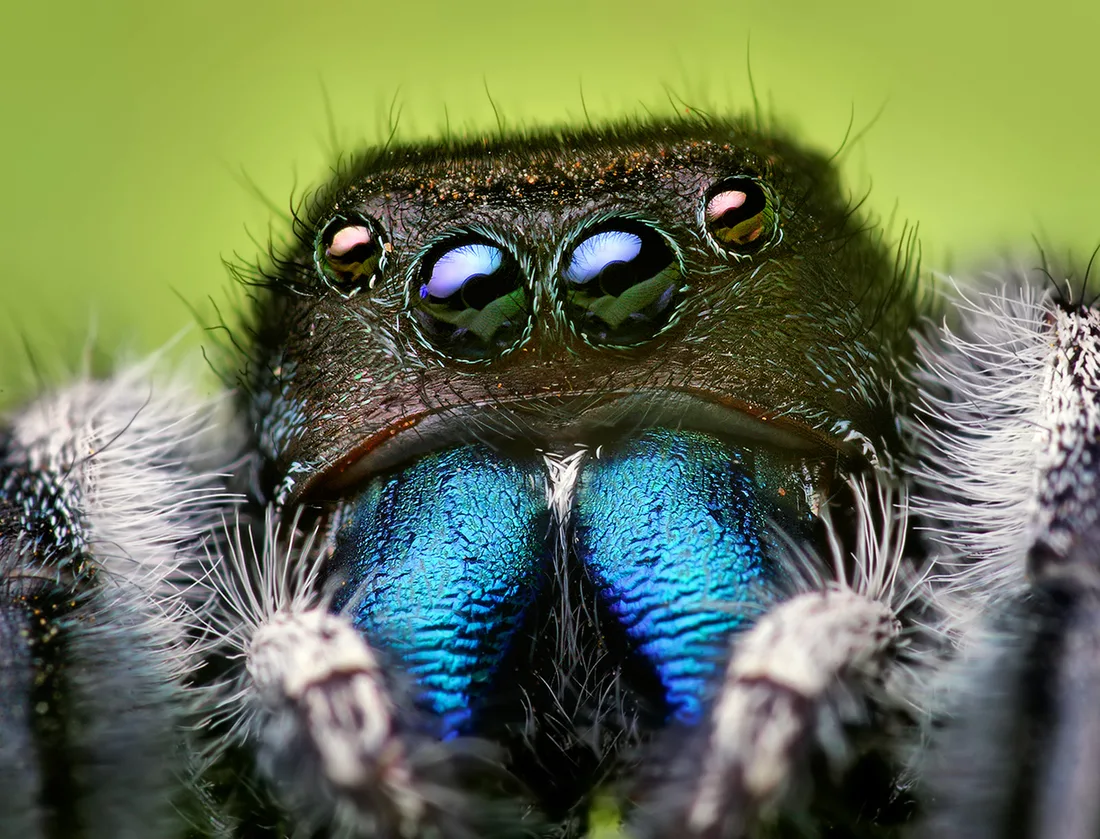
That pattern is unique among the spiders you will meet. The key used by Utah State Extension separates jumping spiders in a single line: four eyes in the front row with the median pair much larger than the side pair, on a hairy compact spider that jumps or moves in rapid jerks.
Something worth knowing about how those eyes work: the big front eyes have a fixed lens with a moving retina behind it. The spider scans by shifting the retina, not the eye. When the two big eyes look darkest to you, you are looking straight down into the retina — which means it is looking straight at you.
How well it actually sees
Extremely well for its size — and the accurate version of that claim is more interesting than the exaggerated one. Jumping spiders achieve higher spatial resolution relative to body size than any other animal. Colorado State Extension calls it the best vision of any spider and possibly of any arthropod.
What it is not is the best eyesight in the animal kingdom. Human acuity is still roughly five to ten times better. The researcher who studies this describes their sight as comparable to much larger animals — pigeons, cats, elephants — which for a spider a few millimetres long is the remarkable part.
The two big front eyes give a narrow, high-detail view, about 5 degrees each. The six smaller eyes give a very wide one: together they cover around 350 degrees — close to the full circle, which is why you cannot sneak up on one.
Colour is more limited than the bright bodies suggest. Most jumping spiders have just two visual pigments, one tuned to green and one to ultraviolet. They do not see the world the way we do. The exception is the genus Habronattus, which gains red through a filter sitting in a small central patch of retina — a mechanism not previously known in spiders.
The jump
A typical jump covers about 10 cm — four inches, several times the spider's own body length. That is the real number, and it is worth stating plainly because the internet numbers are invented.
What the measurements actually show:
- In a controlled study, a 15 mm female Phidippus regius cleared horizontal gaps of four to five body lengths, taking off at 0.52 to 0.97 m/s.
- The largest jump on record for any jumping spider is about 38 times body length, by a 6.2 mm Colonus puerperus — an exceptional escape jump by a small, jump-specialised species.
- The specialist review that recorded it also points out that the popular figures are meaningless without a direction, since any animal can jump a long way down.
The mechanism is genuinely strange. Of the three leg joints that must straighten at take-off, only one has extensor muscles at all. The other two are extended by a surge of internal fluid pressure — the spider squeezes its front body section and the legs snap straight hydraulically. How much of the jump's power comes from that surge versus from muscle directly is still argued about in the literature, so treat "it jumps purely by hydraulics" as the simplified version rather than the settled one.
Before it jumps, it anchors a dragline — a silk safety tether. If it misses, it hangs at the end of the line like a pendulum, then hooks the thread with a claw on a hind leg and climbs back up. If you have ever seen one dangling in mid-air after a failed leap, that is what happened.
Is it a jumping spider or a black widow?
This is the question that brings most people here. A bold jumper is black with a pale or orange spot, and that is enough to start a panic. Here is what actually separates them.
| Bold jumper | Black widow | |
|---|---|---|
| Texture | Hairy and fuzzy | Hairless, glossy, jet black |
| Build | Compact, short legs, blocky front | Bulbous round abdomen on long thin legs |
| Eyes | Two enormous forward-facing eyes | Eight small eyes, none enlarged |
| Jaws | Often iridescent green or blue | No iridescence |
| Web | None — it hunts in the open | Sits in a strong, messy web |
| Movement | Jerky hops, by day, stalks its prey | Hangs in the web in a dark sheltered spot |
One trap to avoid. The obvious rule — "the widow's mark is underneath, so a spot on top means it is safe" — is not reliable on its own. The northern black widow does carry a row of red spots down its back. Use the combination instead: hairy, compact, two huge forward eyes, and no web. Any one of those rules out a widow; all four together settle it.
It is worth knowing the widow's hourglass is variable too — two triangles, two separated triangles, a triangle and a bar, faint red, or on rare occasions absent altogether. How to identify a black widow covers the variation properly.
Jumping spider or wolf spider?
Both have enlarged forward eyes, so this is a real mix-up rather than a silly one. The eye rows separate them, and so does the way they move.
| Jumping spider | Wolf spider | |
|---|---|---|
| Eye rows | Four in the front row, middle two huge | Four small in front, then two large, then two on top (4-2-2) |
| Size | 4–12 mm typically | 1/4 inch to 1 inch |
| Movement | Jerky hops, jumps distances | Runs smoothly over the ground |
| When | Daylight, usually up on plants and walls | Mostly at night, on the ground |
It does not build a web
Jumping spiders catch nothing in silk. They stalk — approaching slowly, then pouncing, in a way people invariably compare to a cat. Only about half of all spider species catch prey with webs, and these are firmly in the other half.
They do make silk, for four things: the dragline they jump on, a retreat for resting at night, moulting and overwintering, the egg sac, and a thread the spiderlings use to balloon away on the wind. If you find a small silk pocket in a crack or under a windowsill, that is a retreat, not a trap.
They hunt by day and need daylight to do it — the opposite of most spiders people worry about. A couple of species that live on buildings in the South, the gray wall jumper and the pantropical jumper, are the exception and will gather around lights at night.
Why it turns to look at you
Because it genuinely is looking. The small side eyes pick up movement, and that triggers the spider to pivot its whole body so the two big forward eyes can point at whatever moved.
Colorado State Extension flags how unusual this is: most spiders flee when detected, while a jumping spider will stay put, turn toward a human, and may even approach rather than run for cover — described as an unusually curious type of behaviour among spiders. It is a whole-body turn, not a head turn; the neck-like motion people describe is the body pivoting, plus that retina moving behind the lens.
The same eyesight drives some of the most elaborate courtship in the animal world. Males combine movement, colour and drumming vibrations into a choreographed species-specific display — waving the forelegs like semaphore, showing off the coloured face, and drumming rhythmic patterns into the surface the female is standing on.
Do jumping spiders bite?
Almost never. They are not aggressive and attempt to bite only if confined against skin, and the jaws of most species are too small to pierce it. Penn State's straightforward finding on the bold jumper: handled, they generally do not bite.
If one does manage it, the result is minor pain, itching, swelling and redness for a day or two, with no complications. On the large regal jumper, Florida's extension service describes a sharp stinging sensation that subsides in a few minutes and needs no treatment. Any bite that draws blood should be cleaned, as any break in skin should.
Sources differ slightly on whether they can break skin at all — Washington State says a bite can penetrate tough skin and is painful, Colorado State says most species' jaws are too small. Both are probably right for different spiders: the large Phidippus can, the small ones generally cannot.
Worth keeping in perspective: most marks people attribute to spiders were not made by spiders. If you have a mark and no spider, the bug bite identifier covers what else leaves one.
The ones you are most likely to see
| Species | Size | How to recognize it |
|---|---|---|
| Bold jumperPhidippus audax | Female 8–19 mm, male 6–13 mm | Black and fuzzy with white, yellow or orange spots on top of the abdomen — orange when young, white when adult. Iridescent green or blue jaws. Canada and the Atlantic coast west to California. |
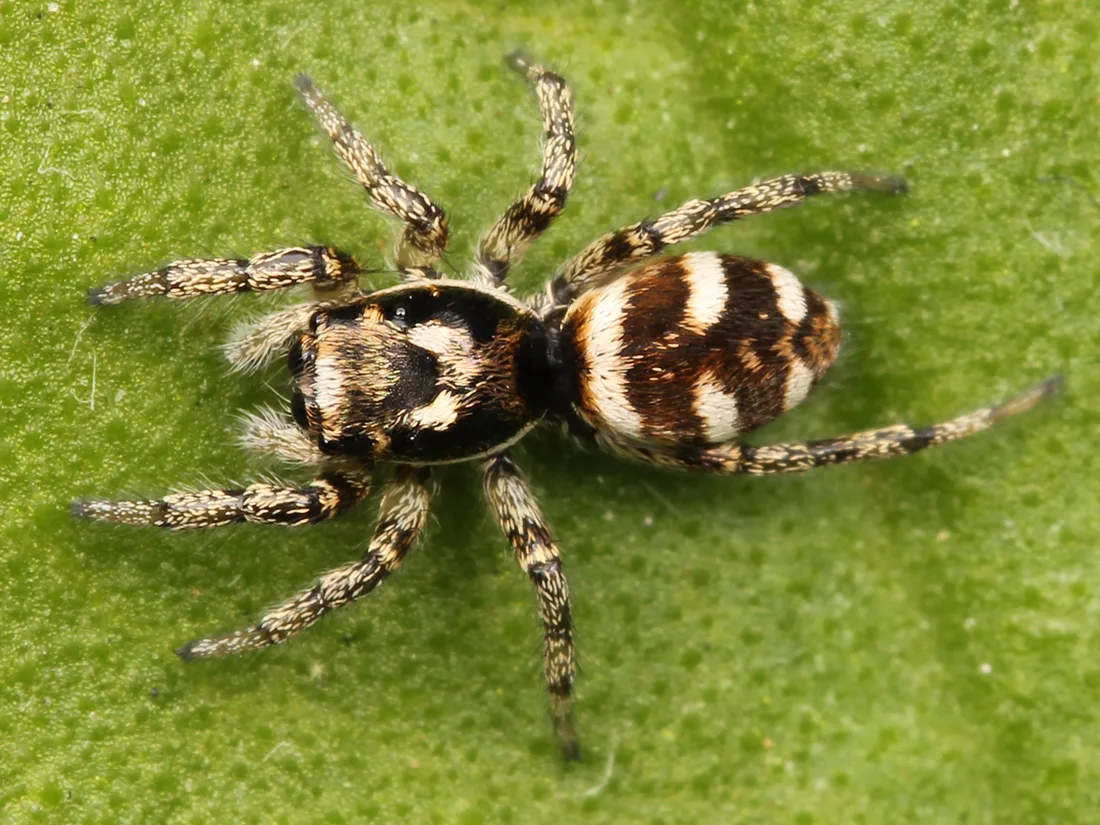
| Zebra jumperSalticus scenicus | 4–6.4 mm | Small, black and white striped. On stones, fences, high grass and both inside and outside buildings. Males have large dark jaws projecting forward. |
| Regal jumperPhidippus regius | Female 7–22 mm, male 6–18 mm | The big one. Males always black with white leg fringes and a white triangle and two oval spots on the abdomen; females grey, tan, brown or orange. Southeastern US, most common in peninsular Florida. |
| Tan jumperPlatycryptus undatus | To 16 mm female, 10 mm male | Greys, tans and browns with an undulating abdominal pattern, and a noticeably flattened body. On tree trunks, fence posts and walls in the eastern US. Curious about people. |
Colorado alone has at least 45 species, so this is a shortlist rather than a catalogue. Some jumping spiders are deliberate ant and beetle mimics, which is worth remembering if something that looks like an ant moves in the wrong way.
Should you get rid of it?
There is no health reason to. Extension services file jumping spiders under beneficial predators: they eat flies, beetles, earwigs, aphids, crickets, grasshoppers, moths, caterpillars, mites and other spiders.
If you want it out anyway, a cup and a piece of card works. It is the same answer as for most spiders indoors — and the house spider guide covers what else you are likely to be sharing the room with.
Two last corrections, because both circulate widely. Jumping spiders are not nocturnal — they need daylight to hunt. And the chain email about a deadly jumping spider under toilet seats was a documented internet hoax; jumping spiders are among the least likely spiders to be found in such a place.
Not sure what you have? The spider identifier reads body shape, leg proportion, eye arrangement and web type from a photo.